

Ladder 7′ A-Frame14′ Extension Ladder
Call for Pricing
Related products
Please Read Before Using Any Rental Ladder
Ladders can cause serious injury if selected, positioned, or used improperly. Always inspect the ladder before use and follow all manufacturer labels, operating instructions, and applicable workplace safety requirements.
- Never exceed the ladder’s rated load capacity. Include the combined weight of the user, tools, equipment, and materials.
- Inspect the ladder before every use. Do not use a ladder that is bent, damaged, cracked, missing parts, or otherwise defective.
- Place the ladder on a stable, level, and secure surface.
- Make sure all hinges, locks, spreaders, braces, and adjustable sections are fully engaged before climbing.
- Ladder rungs and steps should be level and properly positioned when the ladder is in use. OSHA requires ladder rungs, cleats, and steps to be parallel, level, and uniformly spaced when positioned for use. [osha.gov]
- Do not exceed the manufacturer’s permitted standing level.
- Do not overreach. Reposition the ladder instead of leaning excessively to either side.
- Keep ladder steps, rungs, feet, and working surfaces free of oil, grease, mud, water, paint, and other slippery materials.
- Follow the manufacturer’s instructions when using extension, telescoping, articulating, or multi-position ladders.
- For non-self-supporting ladders, use the proper setup angle for the application. OSHA’s construction requirements address the positioning and safe use of portable ladders. [osha.gov]
- When a portable ladder is used to access an upper landing, applicable OSHA requirements must be followed for safe access and ladder positioning.
- Use extreme caution around electrical hazards. Select a ladder appropriate for the work environment.
- Do not move, reposition, extend, or adjust a ladder while someone is climbing or standing on it.
- Never modify a rental ladder or use makeshift extensions, boxes, pallets, or other objects to gain additional height.
- Keep doors, vehicles, equipment, pedestrians, and other jobsite hazards away from the ladder work area.
- Maintain safe climbing and working practices at all times.
OSHA’s construction ladder requirements are covered under 29 CFR 1926.1053, with additional training requirements under OSHA Subpart X
18′ Reach • Type IA • 300 lb Capacity • Fiberglass Multi-Position Ladder
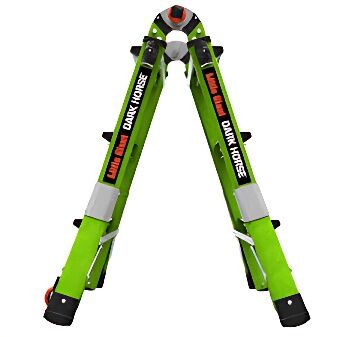
The Little Giant Dark Horse 2.0 M17 is a professional-grade fiberglass multi-position ladder designed for contractors, electricians, painters, maintenance crews, facility teams, and remodelers who need one versatile ladder for a variety of jobs.
The Dark Horse converts into multiple configurations, including an A-frame stepladder, extension ladder, staircase ladder, and 90-degree ladder, allowing crews to adapt the ladder to changing jobsite conditions. Its fiberglass construction, wide-flared base, adjustable rails, and integrated transportation wheels make it a practical choice for demanding commercial and residential work.
With an 18-ft reach classification and a Type IA 300-lb load rating, the Dark Horse M17 provides the strength and versatility needed for professional applications while remaining compact enough for transportation and storage.
Service Rentals & Supplies provides ladder rentals throughout Hawaiʻi, serving customers on Oʻahu, Maui, Big Island, Kauaʻi, Molokaʻi, and Lānaʻi, including Honolulu, Kapolei, Pearl City, Kāneʻohe, Wailuku, Kahului, Lahaina, Kīhei, Kona, Hilo, Waimea, Līhuʻe, Kapaʻa, Poʻipū, Kaunakakai, and Lānaʻi City.
Whether you’re performing electrical work in Honolulu, facility maintenance in Kapolei, painting in Kahului, remodeling in Kona, or handling property repairs in Līhuʻe, the Little Giant Dark Horse M17 provides a flexible elevated-access solution for professional jobs throughout Hawaiʻi.
Key Features
- 18-ft reach classification
- Type IA 300-lb load capacity
- Heavy-duty fiberglass construction
- Multi-position adjustable design
- A-frame configuration
- Extension-ladder configuration
- Staircase configuration
- 90-degree configuration
- Wide-flared base for increased stability
- Quick-adjust rail system
- Integrated Tip & Glide wheels
- Compact folding design for easier transportation and storage
Technical Specifications
| Specification | Detail |
|---|---|
| Manufacturer | Little Giant Ladder Systems |
| Product Family | Dark Horse 2.0 |
| Model | M17 |
| Manufacturer Model | 16117-001 |
| Item Number | 4921735 |
| Ladder Type | Multi-Position |
| Material | Fiberglass |
| Duty Rating | Type IA |
| Rated Capacity | 300 lbs |
| Reach Classification | 18 ft |
| A-Frame Height | Approximately 4–7 ft |
| Extension Height | Approximately 9–15 ft |
| Weight | Approximately 37.5 lbs |
| Configurations | A-frame, extension, staircase, 90-degree |
| Mobility | Integrated wheels |
| Recommended Use | Commercial, construction, maintenance and electrical work |
Ideal Applications
- Electrical installation
- Facility maintenance
- Interior and exterior painting
- HVAC service
- Lighting installation
- Residential remodeling
- Commercial tenant improvements
- Property maintenance
- General construction
- Ceiling access
- Repair and installation work
Please Read Before Using Any Rental Ladder
Ladders can cause serious injury if selected, positioned, or used improperly. Always inspect the ladder before use and follow all manufacturer labels, operating instructions, and applicable workplace safety requirements.
- Never exceed the ladder’s rated load capacity. Include the combined weight of the user, tools, equipment, and materials.
- Inspect the ladder before every use. Do not use a ladder that is bent, damaged, cracked, missing parts, or otherwise defective.
- Place the ladder on a stable, level, and secure surface.
- Make sure all hinges, locks, spreaders, braces, and adjustable sections are fully engaged before climbing.
- Ladder rungs and steps should be level and properly positioned when the ladder is in use. OSHA requires ladder rungs, cleats, and steps to be parallel, level, and uniformly spaced when positioned for use. [osha.gov]
- Do not exceed the manufacturer’s permitted standing level.
- Do not overreach. Reposition the ladder instead of leaning excessively to either side.
- Keep ladder steps, rungs, feet, and working surfaces free of oil, grease, mud, water, paint, and other slippery materials.
- Follow the manufacturer’s instructions when using extension, telescoping, articulating, or multi-position ladders.
- For non-self-supporting ladders, use the proper setup angle for the application. OSHA’s construction requirements address the positioning and safe use of portable ladders. [osha.gov]
- When a portable ladder is used to access an upper landing, applicable OSHA requirements must be followed for safe access and ladder positioning.
- Use extreme caution around electrical hazards. Select a ladder appropriate for the work environment.
- Do not move, reposition, extend, or adjust a ladder while someone is climbing or standing on it.
- Never modify a rental ladder or use makeshift extensions, boxes, pallets, or other objects to gain additional height.
- Keep doors, vehicles, equipment, pedestrians, and other jobsite hazards away from the ladder work area.
- Maintain safe climbing and working practices at all times.
OSHA’s construction ladder requirements are covered under 29 CFR 1926.1053, with additional training requirements under OSHA Subpart X